











Tianeptine (commonly referred to as “gas station heroin”) is an unapproved drug sold at gas stations, vape shops, and online under names like ZaZa, Tianaa, Pegasus, TD Red, and Neptune’s Fix. At high doses, it acts on the same brain receptors as heroin and fentanyl.
Withdrawal symptoms usually peak in the first few days, but low mood and energy can last for weeks after that. Below covers what tianeptine is, what withdrawal involves, how long it lasts, and why medical support matters.
What Is Tianeptine, and Why Is It Called “Gas Station Heroin”?
Tianeptine or “gas station heroin,” is a drug approved as an antidepressant in parts of Europe, Asia, and Latin America. The FDA (U.S. Food and Drug Administration) has never approved it for any medical use in the United States, and it cannot legally be sold as a supplement or added to food and beverages [1].
Tianeptine activates mu-opioid receptors, the same receptors targeted by morphine, heroin, and fentanyl. At the low doses used for depression overseas, that effect is mild. At much higher doses, tianeptine behaves like a full opioid when people take it to chase a high or manage withdrawal [1].
The nickname comes from both halves of the problem: where people buy it (gas stations) and what it does once dependence sets in (acts like heroin on the body).
Is Tianeptine a Problem Today?
Tianeptine has been around far longer than the headlines suggest. It was developed in France in the 1960s and has been prescribed as an antidepressant for decades across Europe, Asia, and Latin America, where it is dispensed at doses around 12.5 mg.
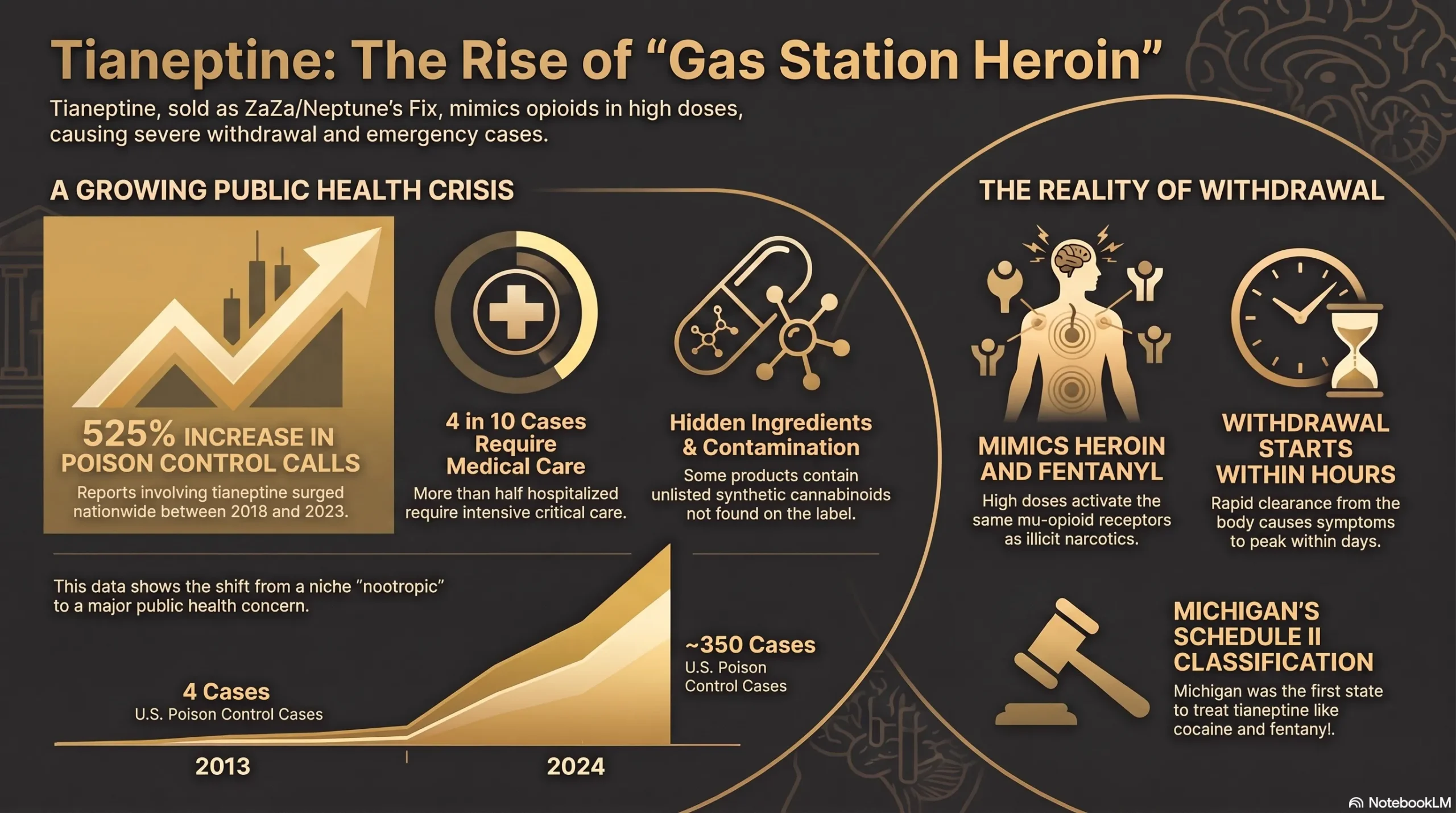
The FDA never approved it here, but that did not keep it out of the country. It arrived quietly in the early 2010s through online vendors and supplement shops, marketed as a nootropic or mood booster, and for a while almost nobody was paying attention. In 2013, U.S. poison control centers logged four tianeptine cases nationwide. By 2024, that number was around 350 [2].
That trajectory is what makes this a different problem than it was a decade ago.
Calls to U.S. poison control centers involving tianeptine rose roughly 525% between 2018 and 2023. In about four out of ten of those cases the person needed medical care, and more than half of those required critical care [2].
Two things have changed since the early days:
The products have gotten stronger. What started as a fringe supplement is now sold in concentrated formulations designed to produce a noticeable effect, which drives faster tolerance and heavier dependence.
They are frequently not just tianeptine. When researchers analyzed bottles of one popular brand after a cluster of severe illnesses, they found other synthetic cannabinoids that were not listed anywhere on the label [6].
 Is Tianeptine Legal in Michigan?
No, and in fact, Michigan was the first state to take action against this drug. In 2018, responding to a cluster of overdoses, Michigan classified tianeptine as a Schedule II controlled substance, the same category as cocaine and fentanyl [3].
When a state cuts off the supply, people who are physically dependent do not simply stop being dependent on it. They go into withdrawal, sometimes abruptly, sometimes without understanding why they feel so sick. Some order online from out of state to avoid it; others try to endure it at home.
If that describes you or someone in your family, the withdrawal you are dealing with is a medical situation, not a character or lack of willpower problem.
How Do Stores Get Away With Selling It?
Tianeptine reaches store shelves through a labeling loophole. Sellers market it as a supplement, a “nootropic,” or a mood booster, and some packages say “not for human consumption.” None of these labels are legal for tianeptine, but the FDA does not review supplements before they are sold. It can only act after a product is already in stores, and new brands often show up faster than old ones are pulled.
Tianeptine is also not banned at the federal level yet, so each state sets its own rules. Michigan banned it in 2018. In states without a ban, gas stations and vape shops can still sell it openly, and people anywhere can order it online.
Is Tianeptine Withdrawal Like Opioid Withdrawal?
Yes, in most ways. At high doses, tianeptine activates mu-opioid receptors, the same receptors that morphine, heroin, and fentanyl act on. When the drug is stopped, the body reacts the way it does when any opioid is stopped. Clinicians track tianeptine withdrawal with the same scale they use for opioid withdrawal, and they treat it with many of the same medications.
A few differences matter:
It can start faster. Tianeptine leaves the body quickly, so symptoms can appear within hours of a missed dose instead of a day or more.
The mood crash can be heavier. Many people first took tianeptine for depression or anxiety. When it stops, those symptoms often come back more intense for a while.
The product may not be pure. Some tianeptine products have contained substances that were not on the label. This can make withdrawal harder to predict, which is one more reason to go through it with a medical team.
What Are the Symptoms of Tianeptine Withdrawal?
Because tianeptine acts on opioid receptors, withdrawal closely resembles heroin withdrawal. An analysis of cases reported to poison control found the most common withdrawal symptoms were agitation and nausea, each in about a third of cases. These were followed by vomiting, rapid heart rate, elevated blood pressure, diarrhea, tremors, and heavy sweating [4].
Additional symptoms that people often do not expect include [5]:
- Muscle aches and worsening of existing pain
- Insomnia that does not respond to normal remedies
- Night sweats and chills
- Anxiety and restlessness
- Deep fatigue and loss of motivation
- Depressed mood, sometimes worse than before use started
- In some cases, blurry vision or hallucinations
Many people started taking tianeptine because they were struggling with depression in the first place. When withdrawal brings that mood crash back harder, it can feel like proof that they need the drug. Clinically, it is the opposite: the brain is recalibrating, and that process improves with time and support.
Tianeptine Withdrawal Timeline: What to Expect
Tianeptine withdrawal has not been studied as thoroughly as opioid withdrawal, so timelines vary based on dose, how long someone has used, and whether other substances are involved [5]:
First 6 to 24 hours
Symptoms often begin faster than people expect, sometimes within half a day of a missed dose. Early signs tend to be anxiety, restlessness, sweating, and stomach upset.
Days 1 to 3:
This period is usually the hardest stretch. Nausea, vomiting, muscle aches, insomnia, elevated heart rate and blood pressure, and significant agitation. This phase is when most people return to use, not because they want to, but because the discomfort is unbearable.
Days 4 to 7:
Physical symptoms generally start to ease. Sleep is often still poor, and appetite takes time to return.
Week 2 and beyond:
The physical piece largely resolves, but low mood, low energy, and difficulty feeling pleasure can linger for weeks. This phase is where relapse risk quietly climbs and where ongoing treatment matters more than detox alone.
 How Is Tianeptine Withdrawal Treated?
Published clinical guidance points to buprenorphine as a first-line treatment for tianeptine withdrawal, with medications like clonidine and other supportive treatments used alongside it to manage symptoms [5]. Care teams commonly track symptoms using the same clinical scale used for opioid withdrawal, which means progress can be measured rather than guessed at.
Withdrawal from tianeptine is rarely fatal on its own, but it is not something to manage alone. Severe cases have landed people in intensive care, particularly when other opioids are involved. Also, the risk of returning to use during the peak days is high enough that medical supervision genuinely changes outcomes.
Rushton Recovery’s Medical Detox Team Can Help You Safely Stop Tianeptine
Many people who call us about tianeptine didn’t know they were dependent until they tried to stop. It may have started as a mood or energy product from a gas station or smoke shop. It may have gotten harder to find after Michigan banned it. Either way, the withdrawal is real, and it is treatable.
At our private 30-acre campus in South Lyon, our residential detox team manages tianeptine withdrawal with evidence-based care, including medication-assisted treatment when it is clinically appropriate. Because so many people turn to tianeptine to manage depression, anxiety, or pain, our residential program also treats co-occurring conditions, not just substance use.
Our admissions team is available now to verify your benefits and help you take the first step.
 Sources
[1] Poison Control. Tianeptine: Gas Station Heroin.
[2] U.S. Food and Drug Administration. Tianeptine Products Linked to Serious Harm, Overdoses, Death.
[3] Legislative Analysis and Public Policy Association. Novel Psychoactive Substances: Tianeptine.
[4] Tianeptine’s Obscured Withdrawal, Presentation, and Treatment.
[5] Saldana, C. et al. (2026). Tianeptine Misuse, Dependence, and Clinical Management: Three Case Reports and Literature Review. Case Reports in Psychiatry.
[6] Counts, C. J., Spadaro, A. V., Cerbini, T. A., Krotulski, A. J., Greller, H. A., Nelson, L. S., Ruck, B. E., & Calello, D. P. (2024). Notes from the field: Cluster of severe illness from Neptune’s Fix tianeptine linked to synthetic cannabinoids — New Jersey, June–November 2023. MMWR Morbidity and Mortality Weekly Report, 73(4), 89–90.