












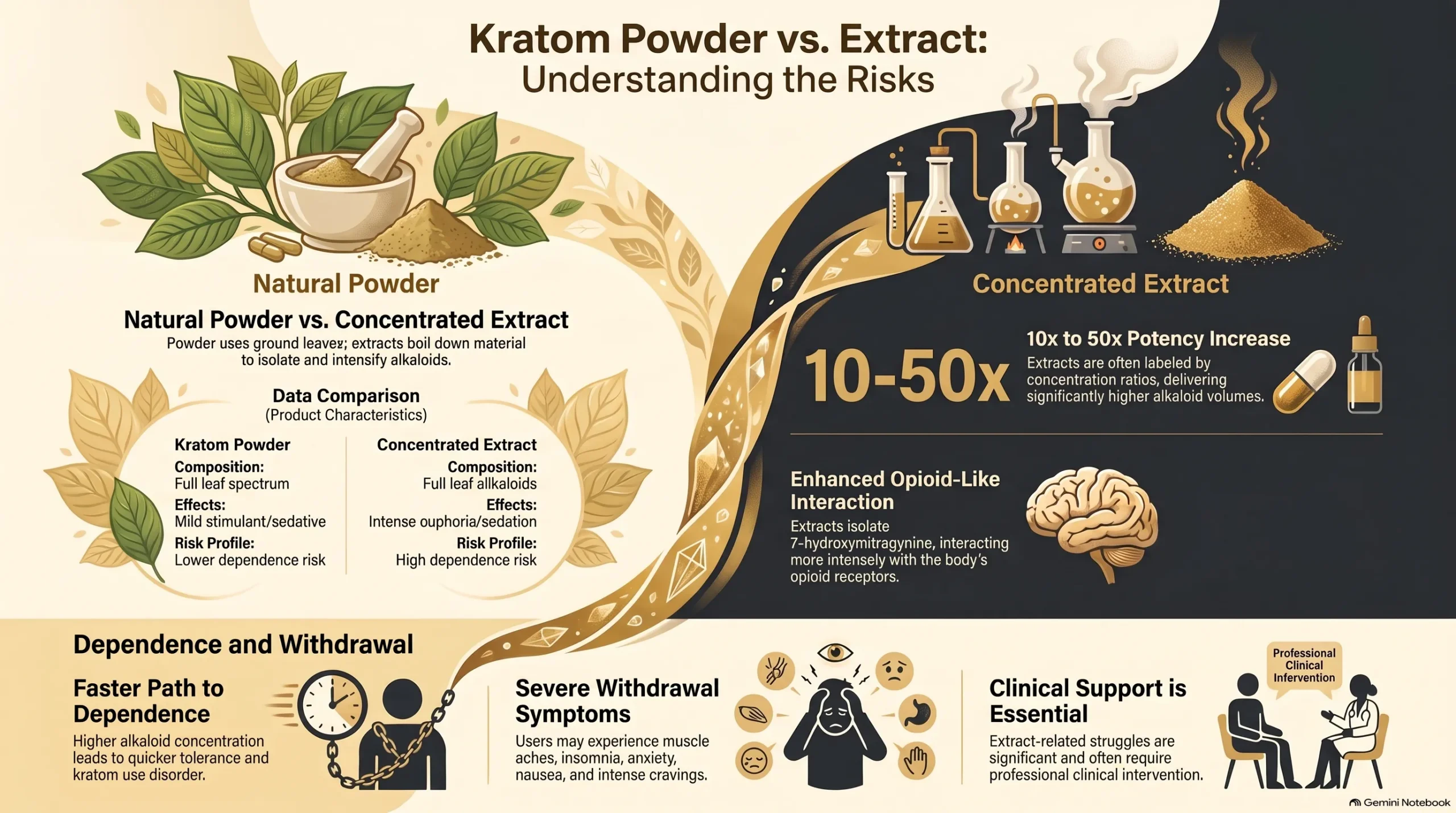
Not all kratom products carry the same risk. Kratom powder, made from dried and ground leaves, is the traditional form and generally produces milder effects and a lower dependence profile.
Kratom extract is a concentrated form, often many times more potent than powder, and is increasingly linked to more severe dependence and more difficult withdrawal.
If you or someone you know has been using kratom extract and is struggling to stop, what you are dealing with is real and it deserves real clinical support.
What Is Kratom?
Kratom, or Mitragyna speciosa, is a plant native to Southeast Asia whose leaves contain active alkaloids, primarily mitragynine and 7-hydroxymitragynine (7-OH), that produce opioid-like and stimulant-like effects depending on the dose [1].
At low doses it tends to act as a stimulant. At higher doses it produces sedation, pain relief, and euphoria similar to opioids.
What Is the Difference Between Kratom Powder and Kratom Extract?
Kratom powder is simply dried kratom leaves ground into a fine powder. It contains the full spectrum of kratom’s naturally occurring alkaloids in roughly the proportions found in the plant itself.
Kratom extract is a concentrated product made by boiling down kratom powder or leaves to isolate and intensify the active alkaloids. Extracts are sold in liquid, resin, or powder form and are labeled by their potency ratio, such as 10x or 50x, indicating how many times more concentrated they are compared to plain powder.
Some commercial products specifically isolate 7-hydroxymitragynine, the alkaloid most responsible for kratom’s opioid-like effects, at concentrations far beyond what occurs naturally in the plant.
Someone using kratom powder is consuming a plant product in a relatively natural form. Someone using a concentrated extract is consuming a pharmacologically different product—one case report has documented severe withdrawal in a patient using concentrated 7-OH, underscoring that higher-concentration products carry a real risk of more intense dependence and withdrawal[2].
 Does Kratom Cause Dependence?
Yes, long-term or high-frequency kratom use can lead to dependence, tolerance, and withdrawal regardless of which form is used.
What varies between powder and extract is the speed and severity of that process. Research found that higher doses and greater frequency of use were both associated with more significant tolerance, withdrawal symptoms, and matched the kratom use disorder criteria [3].
Because extracts deliver significantly higher volumes of active alkaloids per serving, users of concentrated extract products tend to develop dependence more quickly and experience more severe withdrawal when they try to stop.
How Is Kratom Withdrawal Different Between Powder and Extract?
Kratom withdrawal symptoms are consistent across both forms but differ significantly in intensity and duration depending on what was being used, at what dose, and for how long [4].
Common withdrawal symptoms from kratom include:
- Muscle aches and joint pain
- Insomnia and sleep disruption
- Nausea and gastrointestinal discomfort
- Anxiety and irritability
- Sweating and hot and cold flashes
- Restlessness and an inability to sit still
- Intense cravings
- Low mood and depression
Is Kratom Withdrawal Dangerous?
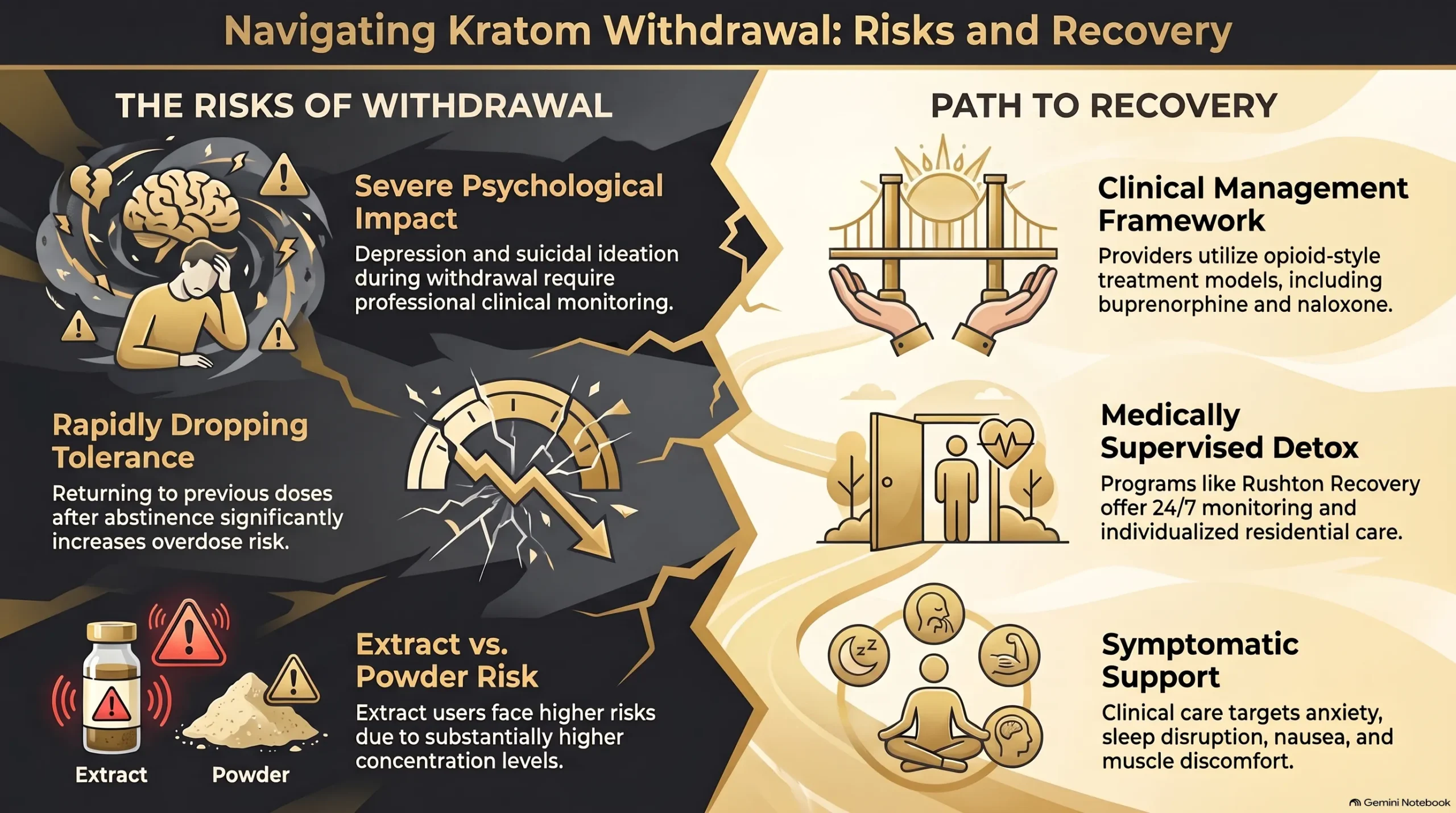
Kratom withdrawal itself is rarely life-threatening in the way that alcohol or benzodiazepine withdrawal can be. However, the psychological symptoms, particularly depression, suicidal ideation, and intense cravings, can become clinically serious and require professional monitoring [5].
People who attempt to stop kratom without support frequently relapse, and because tolerance drops rapidly during abstinence, returning to a previously used dose carries real overdose risk. This risk is amplified for extract users whose previous doses were substantially higher than what standard powder users consume.
What Helps With Kratom Withdrawal?
No FDA-approved medication specifically targets kratom withdrawal, but clinical management follows a similar framework to opioid withdrawal management.
A 2023 report documented successful management of kratom use disorder using buprenorphine and naloxone, suggesting that MAT approaches used for opioid use disorder may have a role in more severe kratom dependence [6].
Medications for anxiety, sleep disruption, nausea, and muscle discomfort can be administered during withdrawal, alongside clinical monitoring for the psychological symptoms that carry the most risk. The most important factor in tapering is consistent clinical support throughout the process.
 Kratom Use Disorder Treatment at Rushton Recovery
If you have been using kratom extract and have found that stopping is harder than you expected, that experience is consistent with what the research describes. What you are dealing with is not a character flaw. It is a pharmacological reality, and it responds to the same quality of clinical care as any other substance use disorder.
Rushton Recovery is a private, medically supervised detox and residential program in South Lyon, Michigan. Our medical team provides evaluation and individualized treatment for substance use disorders, including kratom dependence. We provide around-the-clock clinical monitoring and a residential program that addresses both substance use and its underlying conditions.
We accept Blue Cross Blue Shield and Blue Care Network as in-network carriers and work with most major insurance plans, including Aetna, Cigna, Humana, UnitedHealthcare, Anthem, Carelon, and Magellan.
Our admissions team verifies your benefits the same day you reach out.
 Sources:
[1]Sokup Ivanov, B., & Pippin, M. M. (2023). Kratom. In StatPearls. StatPearls Publishing.
[2] Sharma, A., Nair, B. S., & Pemminati, S. (2025). 7-Hydroxymitragynine and nicotine pouch withdrawal syndrome: A case report. Cureus, 17(12), e98386.
[3] Rogers, J. M., et al. (2024). Kratom addiction per DSM-5 SUD criteria, and kratom physical dependence: Insights from dosing amount versus frequency. Drug and Alcohol Dependence, 260, 111329.
[4] Henningfield, J. E., et al. (2023). Kratom withdrawal: Discussions and conclusions of a scientific expert forum. Drug and Alcohol Dependence Reports, 7, 100142.
[5] Settle, A. G., & Yang, C. (2022). A case of severe kratom addiction contributing to a suicide attempt. Cureus, 14(9), e29698.
[6] Arhin, A., et al. (2023). Successful management of kratom use disorder with buprenorphine and naloxone. Cureus, 15(6), e41146.