












A Vyvanse crash and Vyvanse withdrawal can feel similar, but they are two different things happening at two different points in time. A crash is a short-term response to the medication wearing off within the same day. Withdrawal is what happens when your body has become physically or psychologically dependent on Vyvanse and you stop taking it entirely.
Knowing which one you are experiencing matters because the causes, timelines, and appropriate responses are meaningfully different.
What Is a Vyvanse Crash?
Vyvanse is a long-acting stimulant, which means it is designed to release gradually over the course of the day rather than hitting all at once. When Vyvanse is not taken as prescribed and the medication starts to wear off, it can produce symptoms sometimes called a crash or comedown [1].
Vyvanse crash symptoms typically include:
- Anxiety
- Irritability
- Fatigue
- Mood swings
- ADHD symptoms such as trouble concentrating.
If you have ever taken Vyvanse and found yourself irritable, exhausted, and unable to think straight by late afternoon, that is what a crash feels like. It is not a sign that something is wrong with you. It is just the medication doing what it does, wearing off after a full day, and your brain feeling the difference.
What Is Vyvanse Withdrawal?
Withdrawal occurs when someone who has been using Vyvanse regularly, whether as prescribed or otherwise, stops taking it after the body has adapted to its presence.
The difference between a Vyvanse crash and Vyvanse withdrawal is that a crash is a short-term response to the drug wearing off, whereas withdrawal is the total elimination of the drug from the body.
Physical dependence develops when the body needs the medication to function normally, leading to withdrawal symptoms such as fatigue, headaches, or sleep disturbances when it is reduced or stopped.
Psychological dependence involves a mental or emotional reliance on Vyvanse, which can cause intense cravings, anxiety, or difficulty functioning without the medication.
The key difference is duration and intensity. Where a crash resolves within hours, withdrawal symptoms can persist for days or weeks, and they tend to be more disruptive to daily functioning [1].
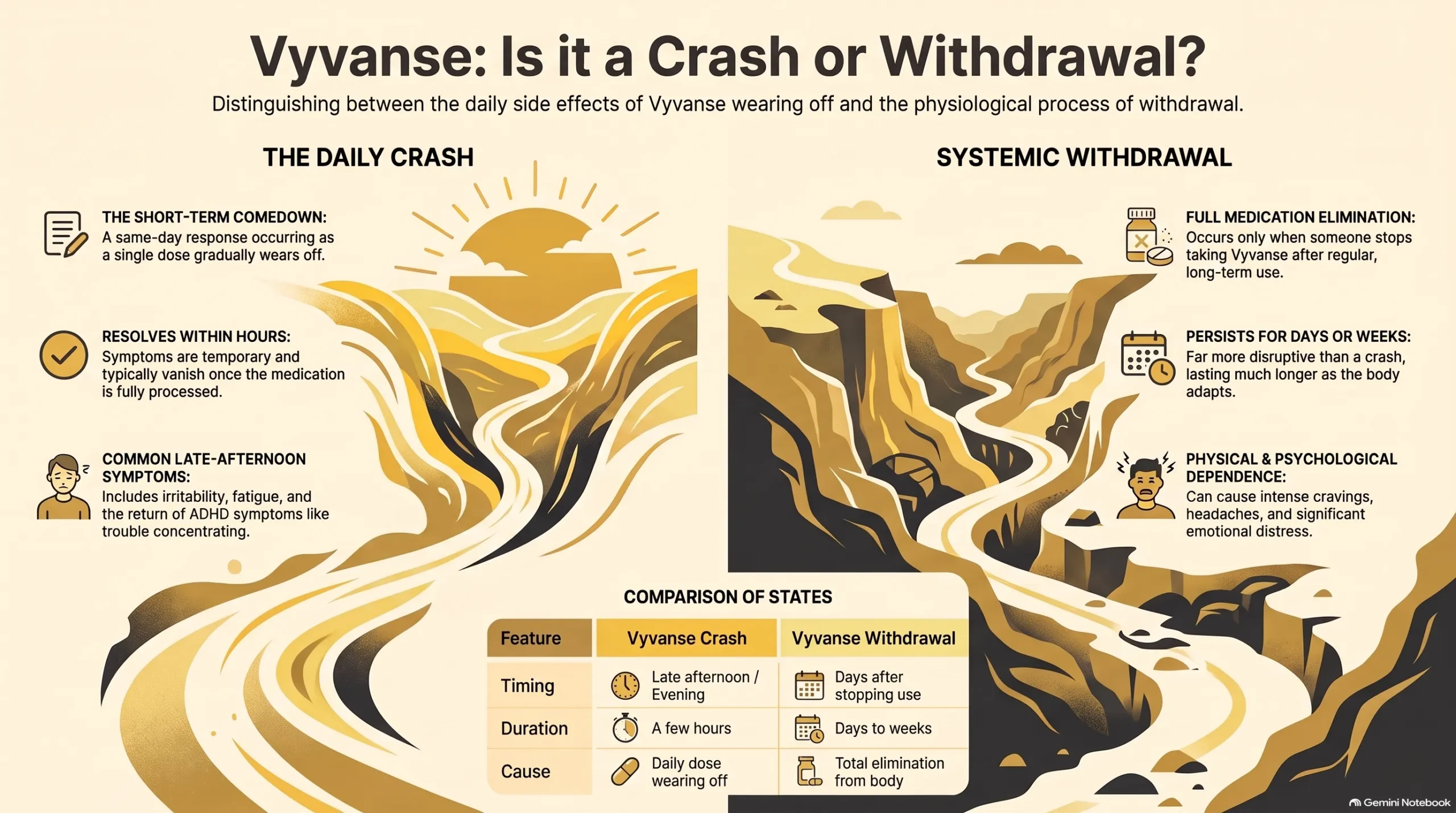 Vyvanse Crash vs Withdrawal: A Quick Glance
| Crash vs Withdrawal | Vyvanse Crash | Vyvanse Withdrawal |
|---|---|---|
| Cause | Medication wearing off after a daily dose | Body adjusting to absence of drug after dependence has formed |
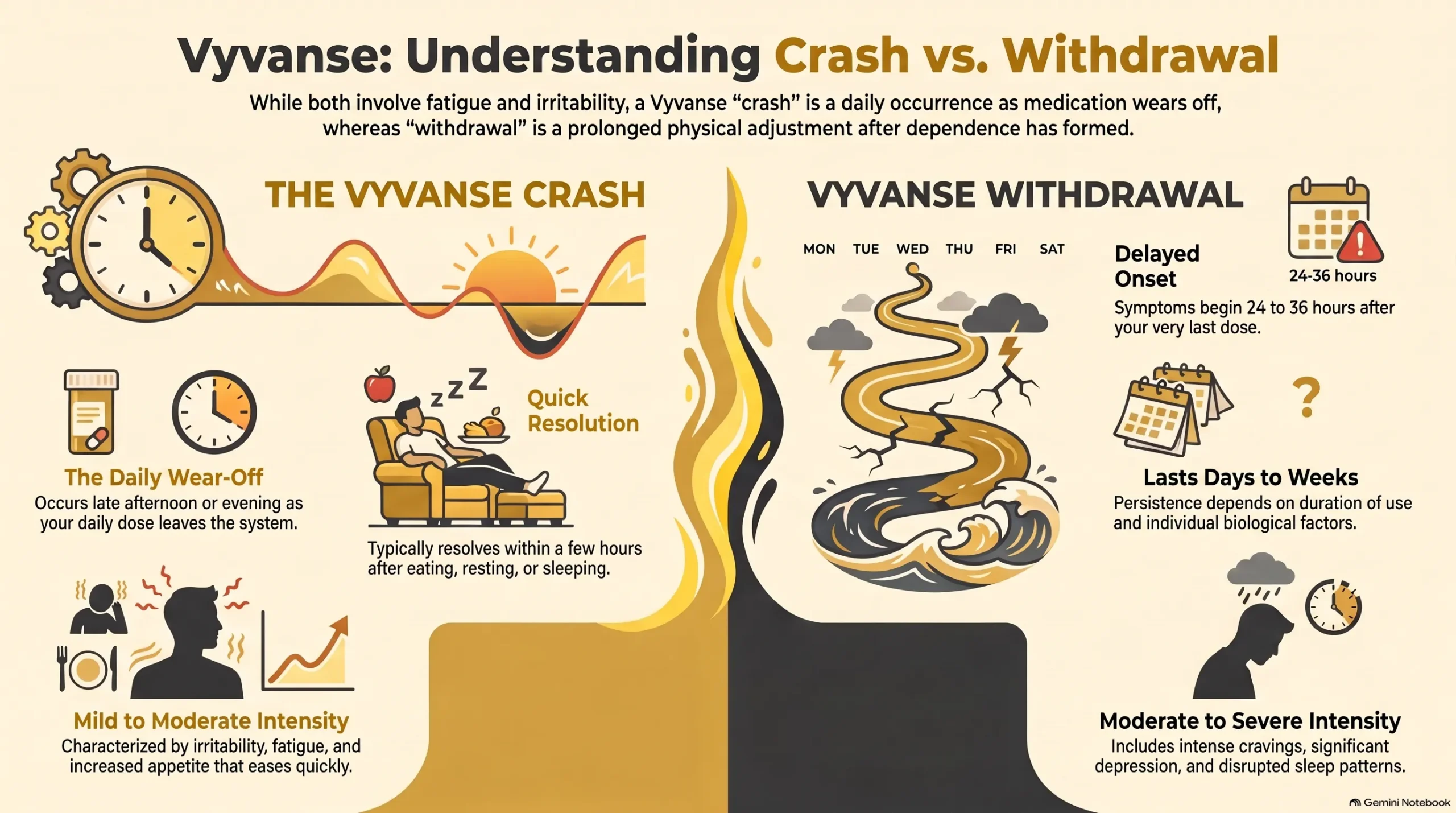
| When it starts | Same day, typically in the late afternoon or evening | 24 to 36 hours after last dose |
| How long it lasts | A few hours, usually resolving after sleeping/eating | Days to weeks depending on duration of use and other individual factors |
| Intensity | Mild to moderate | Moderate to severe |
| Common symptoms | Irritability, low mood, fatigue, trouble focusing, increased appetite | Depression, intense cravings, disrupted sleep, anxiety, headaches |
| How it resolves | Rest, food, sleep | Gradual tapering, medical support, time |
| When to seek help | If crashes are severe or happening daily | If symptoms feel unmanageable or if suicidal thoughts arise |
How Do You Know Which One You Are Experiencing?
The clearest way to distinguish a crash from withdrawal is timing and context.
Crash: If your symptoms appear in the late afternoon or evening on the same day you took Vyvanse, and they ease up after you eat, sleep, or rest, that is most likely a crash.
Withdrawal: If your symptoms begin the day after your last dose, persist for several days, and feel more intense or harder to manage, that is more consistent with withdrawal.
The symptoms overlap significantly. Both can involve fatigue, low mood, irritability, difficulty concentrating, and increased appetite.
What withdrawal adds is a more prolonged and often heavier version of those same symptoms, sometimes accompanied by significant depression, strong cravings, and disrupted sleep that does not resolve after a night of rest.
 Stimulant Use Disorder Treatment at Rushton Recovery
If you have found yourself unable to stop using Vyvanse, struggling through withdrawal on your own, or using stimulants in ways that have started to affect your health, relationships, or work, Rushton Recovery in South Lyon, Michigan, offers the kind of care that meets the full complexity of that picture.
Our medical detox program provides around-the-clock clinical monitoring and psychiatric support for clients going through stimulant withdrawal. Our residential program addresses not just the physical dependence but the underlying drivers, whether that is burnout, performance pressure, trauma, or co-occurring mental health conditions, that made stimulant use feel necessary in the first place.
We work with most major insurance plans, including Blue Cross Blue Shield and Aetna, and our admissions team verifies benefits the same day you reach out. If you are ready to talk, we are ready to listen.
 Sources:
[1] Nall, R. (2018). Coping with a Vyvanse crash. Medical News Today. Medically reviewed by Alan Carter, Pharm. D.